
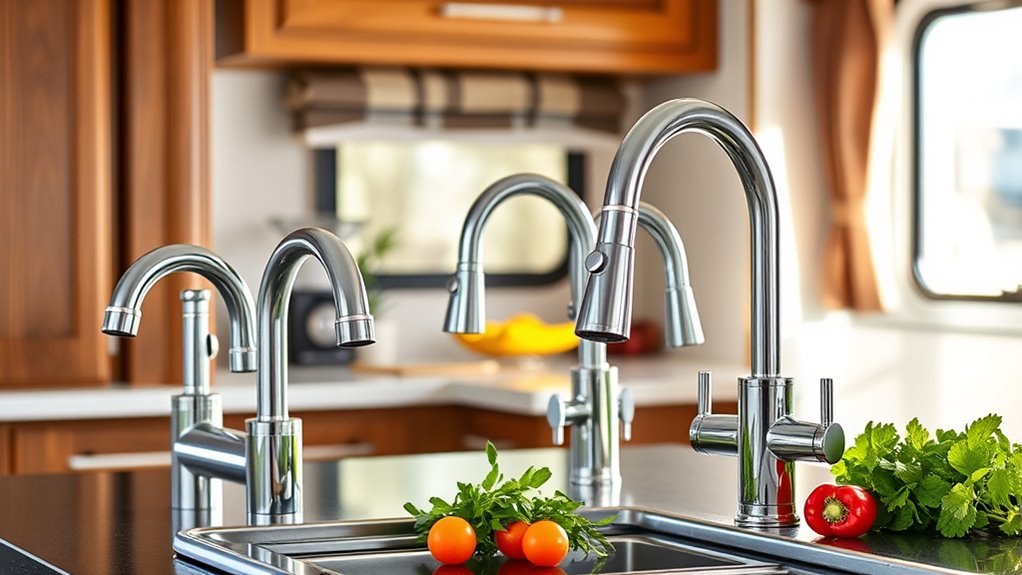
This post breaks down everything you need to know before buying an RV kitchen faucet — from what makes them different from regular home faucets, to the best models on the market right now, installation tips, and how to avoid the most common mistakes RV owners make. Whether you’re full-timing in a Class A motorhome or weekend camping in a travel trailer, there’s something here for you.
Why Your RV Kitchen Faucet Is More Important Than You Think
Most people don’t think twice about the faucet that comes stock with their RV. It works, so why replace it? But here’s the thing — factory-installed RV faucets are often the lowest-cost option the manufacturer could find. They’re made from lightweight plastic, have weak water pressure control, and tend to fail within a few years of regular use.
A quality RV kitchen faucet does a lot more than just let water flow. It affects:
- Water pressure management — RVs operate on varying water pressure depending on campground hookups or onboard pump systems. A good faucet handles both without sputtering or blasting.
- Durability on the road — Vibrations from driving can loosen connections and crack cheap plastic fittings over time.
- Water conservation — Many newer RV faucets include aerators or flow restrictors that help you stretch your freshwater tank further.
- Aesthetic and comfort — Let’s be honest. A sleek, modern faucet makes even a small RV kitchen feel nicer.
“The faucet is one of the most-touched fixtures in any kitchen, RV or otherwise. Upgrading it is one of the highest return-on-investment improvements you can make for daily comfort.” — RV Living Today
RV Kitchen Faucet vs. Regular Home Faucet: What’s the Difference?
This is one of the most searched questions in the RV community, and for good reason. Can you just buy a regular kitchen faucet from Home Depot and slap it in your RV? The short answer: sometimes yes, but usually it’s more complicated than that.
Here’s a quick comparison:
| Feature | RV Kitchen Faucet | Standard Home Faucet |
|---|---|---|
| Mounting hole size | Usually 1-3/8″ | Usually 1-3/8″ to 1-1/2″ |
| Water pressure compatibility | Low to high (variable) | Designed for consistent high pressure |
| Weight | Lightweight preferred | Weight usually not a concern |
| Supply line connectors | 1/2″ or 3/8″ compression or push-fit | Standard 1/2″ IPS |
| Vibration resistance | Needs to withstand travel | Stationary use only |
| Size/profile | Compact preferred | Full size |
The biggest thing to watch out for is water pressure compatibility. Your RV water system can run anywhere from 20 PSI on a pump to 80+ PSI on a campground hookup. Many standard home faucets aren’t designed to handle the low end of that range gracefully, meaning you’ll get that annoying drip-drip at low pressure. Dedicated RV kitchen faucets are built for this range.
Also, RV sinks are often shallower and smaller than residential sinks, so a tall gooseneck faucet might look awkward or make it hard to keep water in the basin.
What to Look for When Buying an RV Kitchen Faucet
Before you click “add to cart” on anything, run through this checklist. There’s a lot of variation in quality and fit, and a little research now saves you a headache at the campsite later.
1. Faucet Material — Brass vs. Plastic vs. Stainless Steel
This is probably the most important factor in longevity. Here’s the breakdown:
- Brass — The gold standard. Naturally corrosion-resistant, durable, and handles temperature changes well. Most premium RV kitchen faucets use a brass body.
- Stainless steel — Great for looks and rust resistance, but can be heavier.
- ABS plastic/chrome-plated plastic — Common in budget faucets. Works fine for a while but tends to crack or leak at the connections after a season or two of travel.
Verdict: If you’re full-timing or traveling frequently, spend the extra money on a brass or solid stainless construction. It’ll outlast two or three cheap plastic faucets.
2. Single vs. Double Handle
- Single handle — Easier to use with one hand when you’re bracing yourself on a moving vehicle (not while driving, obviously), and simpler to install.
- Double handle — Gives more precise temperature control but requires two holes in your sink deck, or a faucet with a base plate to cover existing holes.
For most RV kitchens, single-handle faucets are the more practical choice.
Suggested read: Best 3 Hole Kitchen Faucet Picks That Will Transform Your Sink Setup
3. Spout Height and Reach
Your sink size dictates this more than anything else. Measure your sink depth before buying. A tall gooseneck faucet (great for filling pots) might overflow a shallow RV sink constantly. Look for:
- Spout reach: At least 6–8 inches to reach the center of the basin
- Spout height: 6–10 inches works for most standard RV sinks
4. Pull-Out or Pull-Down Sprayer
A pull-out sprayer is genuinely one of the best upgrades you can make in an RV kitchen. Being able to rinse produce, wash dishes, or fill pots off to the side makes a small sink dramatically more functional. Most modern RV kitchen faucets offer this feature.
5. Flow Rate
Look for a faucet with a flow rate of 1.5 GPM (gallons per minute) or less. This helps conserve your freshwater tank on dry camping trips. Many high-quality models come in at 1.0–1.2 GPM without sacrificing useful water pressure.
6. Mounting Hole Compatibility
Check what size mounting hole(s) your current sink has. Most RV sinks have:
- A single 1-3/8″ hole (most common)
- Sometimes additional holes for sprayers or soap dispensers
Measure before you buy, especially if you’re switching from a single-handle to double-handle setup.
Top RV Kitchen Faucets Worth Buying Right Now
Here are some of the best RV kitchen faucets available in 2026, categorized by use case and budget:
🏆 Best Overall: Dura Faucet DF-NMK630-SN Teapot RV Kitchen Faucet
This is probably the most recommended RV-specific kitchen faucet in the community, and for good reason. Dura Faucet builds products specifically for the RV and marine market, so everything about this faucet is designed with mobile living in mind.
Why it stands out:
- Designed specifically for variable RV water pressure
- Teapot-style spout with elegant curve that fits compact sinks
- Chrome-plated ABS construction (lighter weight for RV use)
- Easy single-hole installation
- Comes with supply lines included
- Available in brushed nickel, chrome, and oil-rubbed bronze finishes
Best for: Travel trailers, 5th wheels, smaller Class C motorhomes
Avg. Price: $65–$85
💪 Best Brass Option: Dura Faucet DF-NMK630-SN (Brass Series)
If you want something more heavy-duty, Dura Faucet’s brass-body series offers the same RV-specific design with a more durable core. It’s a bit heavier but significantly more resistant to the cracking and leaking that plagues plastic RV faucets over time.
Key specs:
Suggested read: Transform Your Cooking Space: Kitchen Wallpaper Ideas That Actually Work
- Solid brass construction
- 360° swivel spout
- Single-handle operation
- 1/2″ supply line connections
- Compatible with both tank and city water hookups
Avg. Price: $90–$120
🚿 Best with Pull-Out Sprayer: WEWE Single Handle Pull-Out Kitchen Faucet
While this isn’t RV-specific, the WEWE pull-out faucet has become hugely popular in the RV community because of its compact profile and affordable price. The pull-out spray head on a 59″ braided hose gives you serious flexibility in a small sink.
Why RVers love it:
- Compact gooseneck fits standard RV sink depths
- 3-function spray head (stream, spray, pause)
- Brushed nickel finish resists fingerprints and water spots
- Low flow rate (1.8 GPM, can be reduced with aftermarket aerator)
- Under $60 in most markets
Best for: Class A motorhomes or RVs with larger, deeper sinks
Avg. Price: $45–$65
💰 Best Budget Pick: Valterra PF221341 Phoenix Single-Handle Kitchen Faucet
Valterra is a well-known name in the RV accessories space. Their Phoenix faucet line is a solid budget option that punches above its price point.
Highlights:
- Built for RV use (handles variable pressure)
- Plastic body but quality construction
- Simple single-hole install
- 1-year warranty
- Under $40
Best for: Occasional campers, weekenders, or those who just need a working faucet fast
Avg. Price: $30–$45
🌟 Best Luxury Pick: Moen 87690SRS Arbor Pull-Down Faucet (RV-adapted)
For the full-timer who wants their rolling home to feel like a real home, the Moen Arbor series (with some adaptation for RV plumbing) is a top-tier option. You’ll need to check your mounting hole size and possibly use a deck plate, but the build quality is unmatched.
Specs:
- Spot Resist stainless steel finish
- Reflex pull-down system with magnetic dock
- Power Boost spray technology
- Lifetime limited warranty from Moen
- Requires standard 1-3/8″ hole
Avg. Price: $200–$280
Suggested read: Why an Oil Rubbed Bronze Kitchen Faucet Is the Jewelry Your Kitchen Needs
RV Kitchen Faucet Comparison Table
| Model | Type | Material | Flow Rate | Price | Best For |
|---|---|---|---|---|---|
| Dura Faucet DF-NMK630-SN | Standard | Chrome ABS | 1.5 GPM | $65–$85 | Most RVers |
| Dura Faucet Brass Series | Standard | Brass | 1.5 GPM | $90–$120 | Full-timers |
| WEWE Pull-Out | Pull-out | Stainless | 1.8 GPM | $45–$65 | Larger sinks |
| Valterra Phoenix | Standard | Plastic | 1.5 GPM | $30–$45 | Budget buyers |
| Moen Arbor (adapted) | Pull-down | Stainless | 1.5 GPM | $200–$280 | Luxury rigs |
How to Install an RV Kitchen Faucet (Step-by-Step)
One of the best things about replacing your RV kitchen faucet is that it’s a genuinely easy DIY job. Most people can do it in under an hour with basic tools. Here’s how:
What You’ll Need:
- Basin wrench or adjustable wrench
- Plumber’s tape (Teflon tape)
- Towels or a small bucket
- New faucet (with supply lines, or purchase separately)
- Flashlight (under-sink visibility is rough)
Step 1: Turn Off the Water Supply
Either shut off your city water connection at the hookup or turn off your onboard water pump. Open the faucet to release any remaining pressure in the lines.
Step 2: Disconnect the Supply Lines
Under the sink, use your wrench to disconnect the hot and cold supply lines from the existing faucet tailpieces. Have your towel ready — some water will drip out.
Step 3: Remove the Old Faucet
Unscrew the mounting nut underneath the sink deck (this is where a basin wrench makes life much easier in tight spaces). Lift the old faucet out from the top.
Step 4: Clean the Sink Deck
Wipe away any old putty, silicone, or grime around the mounting hole. A clean surface helps the new faucet seat properly.
Step 5: Install the New RV Kitchen Faucet
Feed the supply lines through the mounting hole (if the faucet has them pre-attached), then position the faucet from above. Underneath, thread on the mounting hardware and tighten with your basin wrench. Don’t overtighten — most RV sink decks are lighter materials that can crack.
Step 6: Connect the Supply Lines
Wrap the faucet tailpiece threads with Teflon tape (2–3 wraps), then connect your supply lines. Hand-tighten first, then give them a snug quarter-turn with a wrench.
Step 7: Turn On Water and Test
Slowly turn your water back on and check for any leaks at the connections. Run both hot and cold, test the sprayer if applicable, and check under the sink while the water runs.
Total time: 30–60 minutes for most installations
Common Problems with RV Kitchen Faucets (And How to Fix Them)
Even quality faucets run into issues on the road. Here are the most common problems and their fixes:
Problem 1: Low Water Pressure at the Faucet
Cause: Clogged aerator (the small screen at the tip of the spout) Fix: Unscrew the aerator, rinse it clean, and reinstall. If pressure is still low, check your water pump pressure setting or inlet filter.
Problem 2: Dripping When Water Is Off
Cause: Worn cartridge or O-ring inside the faucet body Fix: Replace the cartridge (usually a $5–$15 part, faucet-specific). This is a 20-minute fix on most single-handle faucets.
Suggested read: Why a Stainless Steel Kitchen Wash Basin Is the Best Investment You'll Ever Make for Your Home
Problem 3: Faucet Wobbles at the Base
Cause: Loose mounting nut underneath the sink Fix: Tighten the mounting nut with a basin wrench. If the hole is worn or oversized, add a rubber gasket or use silicone sealant around the base.
Problem 4: Sprayer Hose Won’t Retract
Cause: Kink in the hose under the sink, or counterweight issue Fix: Clear obstructions under the sink. Many pull-down faucets use a counterweight on the hose — ensure it’s properly clipped.
Problem 5: Discolored Water After Installation
Cause: Air in lines or residue from new supply lines Fix: Run the water for 2–3 minutes to flush the system. This is totally normal after any plumbing work.
How to Conserve Water with Your RV Kitchen Faucet
Water conservation is a big deal if you do any dry camping (boondocking). Here are some practical tips that work specifically with your RV kitchen faucet:
- Install a low-flow aerator — You can swap the aerator on most faucets to a 0.5 or 1.0 GPM model for under $5. It massively reduces water usage with barely noticeable pressure difference.
- Use the pause button — If your pull-out faucet has a pause function on the spray head, use it constantly while soaping dishes.
- Fix drips immediately — A faucet dripping once per second wastes about 3,000 gallons of water per year. In an RV tank context, that drip is emptying your tank faster than you think.
- Fill a small basin for rinsing — Rather than letting water run during dish rinsing, fill a small plastic tub in the sink with rinse water and dip dishes in that.
Case Study: Full-Timer Switches to a Quality RV Kitchen Faucet
Sarah and Mike, a couple full-timing in a 2019 Forest River Forester 3051SF, replaced their stock plastic faucet after it started leaking at the base about 14 months into their travels.
They upgraded to the Dura Faucet brass series after researching in RV forums. Their findings after 8 months of use:
- Zero leaks since installation
- Noticeably better water pressure control (they frequently switch between 20 PSI pump pressure and 60+ PSI campground water)
- The 360° swivel made their small sink dramatically more functional
- Installation took Mike about 45 minutes with no professional help
“It cost us $95, which felt like a lot at the time, but the stock faucet was going to cost us $150 in repairs. We should’ve done this on day one,” Mike shared in a Forest River Owners Group post.
Where to Buy Your RV Kitchen Faucet
You’ve got a few options, and each has trade-offs:
1. Amazon
Largest selection, competitive prices, fast shipping. Great for brands like Dura Faucet, WEWE, and Valterra. Read the reviews carefully — filter by verified purchase and look for people specifically mentioning RV use.
2. Camping World / Gander RV
Brick-and-mortar option with staff who (sometimes) know RV plumbing. Good for seeing physical size before buying. Prices are typically higher than online.
3. RV Parts Country / RecPro
Smaller specialty RV parts retailers online. Great for RV-specific brands and parts that don’t show up on Amazon. Often have better product knowledge in their listings.
4. Home Depot / Lowe’s
Good for residential faucets that you’re adapting for RV use (like the Moen or Delta options). Staff may not know RV applications, but the product is there and you can see it in person.
Suggested read: Best Kitchen Wrap Brand: What to Use, What to Buy, and Why It Actually Matters
👉 Ready to upgrade your setup? Shop RV kitchen faucets on Amazon and find your perfect match today.
FAQs About RV Kitchen Faucets
Can I use a regular kitchen faucet in my RV?
Yes, in most cases you can — but you need to check a few things first. Make sure the mounting hole size matches (usually 1-3/8″), the faucet handles low water pressure without dripping, and the spout height is appropriate for your shallow RV sink. Many residential faucets work fine, but RV-specific faucets are built for the variable pressure and vibration that comes with travel.
What size hole does an RV kitchen faucet need?
Most RV kitchen faucets use a standard 1-3/8 inch (35mm) mounting hole, which is the same as most residential kitchen faucets. Always measure your existing hole before purchasing to confirm compatibility.
How do I stop my RV kitchen faucet from dripping?
The most common cause is a worn cartridge or O-ring inside the valve body. You can usually buy a replacement cartridge for your specific faucet model for $5–$20. If the drip is at the base of the spout or at supply line connections, tighten the connections or replace the O-rings on the supply line fittings.
What’s the best RV kitchen faucet for boondocking?
For boondocking (dry camping without hookups), you want a faucet with a low flow rate (1.0–1.5 GPM) to conserve your freshwater tank. The Dura Faucet DF-NMK630-SN is a top pick because it’s designed specifically for RV water systems and handles low pump pressure well.
How often should I replace my RV kitchen faucet?
A quality brass RV kitchen faucet can last 10+ years with proper care. Budget plastic faucets often need replacement within 2–4 years, especially with frequent travel. Watch for drips, wobbling, or mineral buildup as signs it might be time to replace.
Are pull-out RV kitchen faucets worth it?
Absolutely — especially if you cook frequently in your RV. A pull-out sprayer makes rinsing produce, washing large items, and filling pots dramatically easier in a small sink. It’s one of the most functional upgrades you can make to an RV kitchen.
Do RV kitchen faucets come with supply lines?
Many do, but not all. RV-specific brands like Dura Faucet typically include supply lines in the box. Residential faucets often do not. If yours doesn’t come with supply lines, you’ll need 3/8″ compression to 1/2″ FIP braided supply lines, available at any hardware store for a few dollars.
Final Thoughts — Upgrade Your RV Kitchen Faucet and Actually Enjoy Cooking on the Road
Here’s the bottom line: your RV kitchen faucet is a small thing that makes a big difference in daily life on the road. Spending $60–$120 on a quality replacement is one of the smartest and easiest upgrades you can make to your rig. It’s a one-hour install, it lasts for years, and you’ll appreciate it every single time you wash a dish or fill a pot.
If you’re not sure where to start, go with the Dura Faucet DF-NMK630-SN — it’s RV-specific, affordable, widely available, and the most consistently praised option in the community. If you want something more premium with a pull-out sprayer, step up to the WEWE or a brass Dura Faucet model.
Don’t let a cheap, wobbly, dripping stock faucet ruin your kitchen vibes. Upgrade it, enjoy it, and get back to the good stuff — like exploring wherever the road takes you next.
👉 Find the best RV kitchen faucet for your rig right here — free shipping on most models and easy returns if the fit isn’t right.
Citation: Dura Faucet. (2024). RV & Marine Faucets — Product Overview. Retrieved from https://www.durafaucet.com. | RV Living Today. (2024). RV Kitchen Upgrades That Actually Matter. Retrieved from https://www.rvlivingtoday.com.

Author and contributor.
