
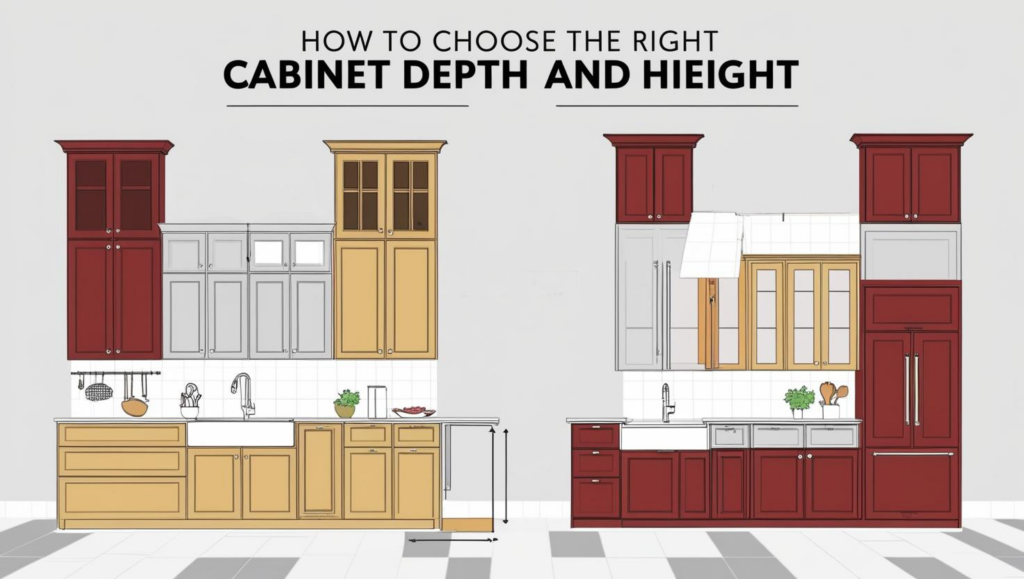
If you’ve ever walked into a kitchen and thought, “something feels off here” — there’s a good chance the cabinet heights were just slightly out of whack. Kitchen cabinet height is one of those things that seems super simple on the surface, but actually has a ton of nuance behind it. Get it right, and your kitchen feels effortless. Get it wrong, and you’re craning your neck, straining your back, or wasting precious storage space every single day.
Whether you’re planning a full kitchen remodel, building from scratch, or just trying to figure out why your current kitchen feels awkward, this guide breaks it all down. We’re talking real measurements, expert rules of thumb, ergonomics, building codes, and the kind of practical advice that actually helps when you’re standing in the middle of a half-finished kitchen renovation.
What Is Standard Kitchen Cabinet Height?
Before we get into the details, let’s talk about what “standard” actually means when it comes to kitchen cabinet height. In the U.S., kitchen cabinets generally come in three main sections: base cabinets, wall (upper) cabinets, and tall (pantry or oven) cabinets. Each of these has its own standard height — and yes, they’re all different.
Here’s a quick overview:
| Cabinet Type | Standard Height | Notes |
|---|---|---|
| Base Cabinets | 34.5 inches | Countertop adds ~1.5″ to reach 36″ total |
| Wall/Upper Cabinets | 12–42 inches tall | Usually hung 18″ above the countertop |
| Tall/Pantry Cabinets | 84–96 inches | Floor to near ceiling |
| Total Counter Height | 36 inches | Industry standard working surface height |
These measurements come from decades of kitchen design practice, ergonomics research, and manufacturing standardization. The National Kitchen and Bath Association (NKBA) has been a huge part of setting these guidelines, and most major cabinet manufacturers (IKEA, KraftMaid, Merillat, etc.) build to these specs.
“The standard 36-inch counter height works for the average person standing around 5’8″ to 5’10”. But the truth is, ‘average’ leaves a lot of people uncomfortable.” — Kitchen design expert consensus, NKBA Guidelines
Why Kitchen Cabinet Height Actually Matters More Than You Think
Here’s where a lot of people go wrong: they just go with whatever the showroom or builder suggests without thinking about their own body and how they actually use their kitchen. Kitchen cabinet height isn’t just an aesthetic choice — it’s deeply tied to ergonomics, safety, and how comfortable your kitchen is to use every single day.
Consider this: the average American spends 37 minutes per day preparing food at home, according to the U.S. Bureau of Labor Statistics. If your counters are too low, you’re hunching. If your upper cabinets are too high, you’re constantly reaching on your tiptoes. Over months and years, that adds up to real physical strain.
Key reasons kitchen cabinet height matters:
- Ergonomics & comfort — Working at the wrong height causes back, shoulder, and neck pain over time
- Safety — Overhead cabinets placed too low can be a head-hazard, especially in smaller kitchens
- Functionality — Poorly placed cabinets make daily tasks harder and less efficient
- Resale value — Non-standard heights can put off future buyers
- Accessibility — ADA and universal design guidelines exist for a reason — they make kitchens work for more people
Breaking Down Kitchen Cabinet Height by Cabinet Type
H2: Base Cabinet Height — The Foundation of Everything
Base cabinets are the lower cabinets that sit on the floor and support your countertops. The standard base cabinet height is 34.5 inches, and when you add a standard countertop (usually 1.5 inches thick), you land at the magic number: 36 inches total.
That 36-inch counter height has been the industry standard for decades, and for good reason. It roughly aligns with the elbow height of someone who is about 5’8″ to 5’10” — which happens to be close to the average height of American adults. When your elbows are slightly bent while your hands rest on the counter, that’s your ideal working height.
What if you’re not average height?
Suggested read: Rustic Kitchen Cabinets: How to Get That Warm, Cozy Look Without Breaking the Bank
This is where custom or semi-custom cabinetry comes in. Here are some general adjustments based on user height:
| User Height | Recommended Counter Height |
|---|---|
| Under 5’3″ | 32–34 inches |
| 5’3″ to 5’8″ | 34–36 inches |
| 5’9″ to 6’1″ | 36–38 inches |
| Over 6’1″ | 38–40 inches |
Some homeowners opt for varying counter heights across different zones — like a lower prep area for rolling dough and a higher area near the stove. This is sometimes called a “multi-level kitchen” and it’s getting more popular in modern kitchen design.
H2: Upper Cabinet Height — How High Should Wall Cabinets Be?
Upper or wall cabinets are the ones mounted above your countertops. The standard kitchen cabinet height for upper cabinets is typically 18 inches above the countertop surface (not above the base cabinet — above the countertop). This puts the bottom of your upper cabinets at about 54 inches from the floor.
Wall cabinets themselves come in varying heights:
- 12-inch tall — often used above refrigerators or for decorative purposes
- 15-inch tall — good for storing spices or small items
- 18-inch tall — common in kitchens with lower ceilings
- 30-inch tall — the most common standard height for upper cabinets
- 36 and 42-inch tall — used when you want cabinets to reach the ceiling or near it
The gap between your countertop and the bottom of the upper cabinet matters a lot. 18 inches is the minimum recommended clearance — it gives you enough space to use small appliances like a toaster or coffee maker without them being blocked. Some designers push this to 20 inches for more visual breathing room.
Why the 18-inch rule exists:
- Gives clearance for countertop appliances (average toaster is about 8–10 inches tall)
- Keeps the backsplash visible and functional
- Allows comfortable workspace below without feeling cramped
- Prevents the kitchen from feeling visually heavy
H2: Ceiling Height and How It Affects Kitchen Cabinet Height
Here’s something a lot of people don’t think about until it’s too late: the height of your ceiling dramatically impacts how you should approach kitchen cabinet height. Standard U.S. home ceiling heights have shifted over the years, and different eras of home construction have very different norms.
- 8-foot ceilings — the most common in older homes; standard upper cabinets leave a gap of 12–18 inches at the top
- 9-foot ceilings — increasingly common in modern construction; gives more flexibility for taller upper cabinets
- 10-foot+ ceilings — found in high-end or newer construction; allows full-height cabinetry or decorative top sections
The gap problem: When your upper cabinets don’t reach the ceiling, you get a “floating” look that can feel unfinished and also creates a dust-collecting dead zone. Here are your main options for handling this:
- Use taller 42-inch upper cabinets to get closer to the ceiling
- Add a crown molding or soffit to bridge the gap decoratively
- Use open shelving above standard cabinets for a modern look
- Install cabinets all the way to the ceiling for maximum storage (requires a step stool for top shelves)
H2: Kitchen Cabinet Height for Standard vs. Custom Kitchens
Not everyone gets to go full custom. A lot of homeowners are working with stock cabinets from big-box stores, and that’s totally fine — but it helps to know the limits.
Stock cabinets are manufactured to standard dimensions and are the most affordable option. They come in fixed height, width, and depth increments.
Semi-custom cabinets offer some flexibility — you can usually get non-standard heights, widths, or specific features added.
Custom cabinets are built to your exact specs, which means you can do anything — varying counter heights, extra-tall upper cabinets, or ADA-compliant designs.
Suggested read: Why Aqua Fusion Quartzite from Brazil Is the Most Stunning Kitchen Stone You Will Ever Use
| Cabinet Type | Height Flexibility | Price Range | Lead Time |
|---|---|---|---|
| Stock | None — fixed sizes | $80–$400/linear ft | In stock |
| Semi-Custom | Limited adjustments | $150–$650/linear ft | 4–6 weeks |
| Custom | Fully customizable | $500–$1,500+/linear ft | 8–16 weeks |
ADA-Compliant Kitchen Cabinet Height — Designing for Everyone
If you’re designing a kitchen for someone who uses a wheelchair, has limited mobility, or you just want a universally accessible space, ADA (Americans with Disabilities Act) guidelines give you specific kitchen cabinet height recommendations that differ from the standard.
Key ADA kitchen design guidelines include:
- Countertop height: 28–34 inches (lower than standard 36 inches)
- Knee clearance below counter: At least 27 inches high, 30 inches wide, and 19 inches deep
- Upper cabinet reach range: No higher than 48 inches from the floor (forward reach) or 54 inches (side reach)
- Accessible storage zone: Between 15 and 48 inches from the floor for comfortable reach
These aren’t just for people with disabilities — they’re great design principles for aging-in-place kitchens. If you’re remodeling and plan to stay in your home long-term, incorporating some ADA principles now can save a costly renovation later.
How to Measure Kitchen Cabinet Height Like a Pro
Getting your measurements right before installation is absolutely critical. A mistake here isn’t easy to undo. Here’s a step-by-step breakdown:
Tools you’ll need:
- Tape measure
- Level
- Stud finder
- Pencil
- Laser level (optional but very helpful)
Step-by-step measuring process for kitchen cabinet height:
- Find your highest floor point — floors are rarely perfectly level. Use a level and find the highest point, because all cabinet heights should be measured from there.
- Mark the base cabinet top line — measure 34.5 inches up from the highest floor point and draw a level line across the wall. This is where your base cabinets will sit.
- Mark the countertop line — add 1.5 inches (standard countertop thickness) to get to 36 inches. This helps you visualize the working surface.
- Mark the upper cabinet bottom line — measure 18 inches above the countertop line (54 inches from the highest floor point) and draw another level line. This is where the bottom of your upper cabinets will go.
- Mark the upper cabinet top line — add your upper cabinet height (e.g., 30 inches) to get to 84 inches. This tells you how much space remains before the ceiling.
- Locate studs — use your stud finder to mark stud locations. Upper cabinets must be anchored into studs, not just drywall.
Pro tip: Always double-check your lines with a laser level if you have one. Even a tiny error across 10 feet of cabinetry is visible and can cause major headaches during installation.
Kitchen Cabinet Height and Appliances — What You Need to Know
Your appliances don’t operate in a vacuum (pun intended). The height of your kitchen cabinets needs to work around your appliances — specifically the refrigerator, range hood, dishwasher, and oven.
Refrigerator clearance: Standard refrigerators are 65–69 inches tall. If you’re doing upper cabinets above the fridge, you’ll usually use shorter 12-inch cabinets in that spot, giving you enough clearance without things looking weird.
Range hood height: This is a safety issue, not just a design one. The bottom of a range hood should typically be 24–30 inches above the cooking surface (the actual burners). Check your specific hood’s manufacturer guidelines, because this varies.
Dishwasher: Standard dishwashers are 34 inches tall (not counting adjustable feet), which aligns perfectly with standard base cabinet height. Most modern dishwashers have adjustable feet to help you get a flush fit.
Wall ovens: These are usually built into tall cabinets. The standard recommendation is to position the oven door handle at elbow height (about 36 inches) so you’re not bending or straining to load and unload heavy dishes.
Suggested read: The Surprisingly Underrated Thai Kitchen Menu Dishes Most People Never Order
Real Case Study: How One Homeowner Got Kitchen Cabinet Height Exactly Right
The situation: Sarah and Marcus were renovating a 1970s ranch house with 8-foot ceilings. Sarah is 5’4″ and Marcus is 6’2″. They both cook regularly. Their previous kitchen used standard 36-inch counter height everywhere, and Marcus loved it while Sarah found it too high for comfortable chopping.
Their solution: They worked with a semi-custom cabinet company to create a multi-level kitchen layout.
- Main countertop area: 34 inches (more comfortable for Sarah’s daily prep work)
- Island/bar top: 38 inches (Marcus’s preferred work height, also doubles as a casual eating surface)
- Upper cabinet bottom: 52 inches from floor (18 inches above 34-inch counter)
- Upper cabinet height: 36 inches tall (reaching 88 inches, bridged the gap to ceiling with crown molding)
The result: Both partners are happy with the kitchen. No more back pain for either of them, and the varied heights add visual interest to the space. Total additional cost over standard stock cabinets? About $3,200 — which they said was 100% worth it.
Common Kitchen Cabinet Height Mistakes (And How to Avoid Them)
Let’s be real for a second. Kitchen renovations are expensive, and cabinet height mistakes are one of the most common — and costly — errors homeowners make. Here are the big ones to watch out for:
Mistake #1: Ignoring the actual users’ heights Don’t just go with standard measurements. Think about who’s going to use this kitchen every day and adjust accordingly.
Mistake #2: Hanging upper cabinets too low Going below 18 inches of clearance above the countertop feels cramped and limits what appliances you can use on the counter. Don’t do it.
Mistake #3: Not accounting for the ceiling Leaving a random gap between your upper cabinets and the ceiling looks unfinished. Plan for this from the start.
Mistake #4: Forgetting about the range hood Range hood placement is often an afterthought — but if you install your upper cabinets first and then realize the hood doesn’t fit comfortably, you’ve got a major problem.
Mistake #5: Measuring from an uneven floor Always find the high point of your floor and measure from there. Floors are almost never perfectly level, and if you ignore this, your cabinets will be uneven even if your measurements seem right.
Mistake #6: Not getting permits In many jurisdictions, a full kitchen remodel requires a permit. Unpermitted work can cause issues when you go to sell. Check with your local building department.
Kitchen Cabinet Height for Small Kitchens — Maximizing Every Inch
Small kitchens have their own set of challenges when it comes to kitchen cabinet height. Here’s how to make the most of limited space:
- Go full height with upper cabinets — in a small kitchen, every inch of storage counts. Run cabinets all the way to the ceiling.
- Use glass-front upper cabinets — this keeps the space from feeling cave-like while still giving you storage
- Consider open shelving above the standard upper cabinet line to store less-used items
- Don’t sacrifice the 18-inch clearance — even in a small kitchen, you need that breathing room above the counter
- Think vertically — tall pantry cabinets are your best friend in a small kitchen
A small kitchen fact worth knowing: According to Houzz’s 2023 Kitchen Trends Study, kitchens under 70 square feet are the most renovated category in the U.S., and maximizing vertical storage is the #1 reported goal in those projects.
Suggested read: Single Bowl Kitchen Sink Buyer's Guide: Finding the Perfect Sink for Your American Kitchen
Kitchen Cabinet Height Codes and Standards — What You’re Required to Follow
Beyond design preference, there are actual building codes and professional standards that govern kitchen cabinet height in some contexts. These are particularly important if you’re doing a permitted renovation or building a new home.
Key standards to know:
- NKBA (National Kitchen & Bath Association) — publishes voluntary design guidelines that most professionals follow
- IBC (International Building Code) — governs structural and safety requirements
- ADA Standards — apply if the home must meet accessibility requirements
- Local building codes — always take priority; check with your municipality
Most residential kitchen renovations don’t have strict code requirements on cabinet height specifically (as opposed to structural work, electrical, or plumbing). But if you’re doing a commercial kitchen or an ADA-compliant renovation, the rules get much more specific.
Source and Citation for Kitchen Cabinet Height
For official guidance on kitchen cabinet height standards, the National Kitchen and Bath Association (NKBA) publishes their NKBA Kitchen and Bathroom Planning Guidelines with Access Standards, which is the industry’s go-to reference. You can access it at: www.nkba.org
Additional authoritative sources:
- The American Institute of Architects (AIA) — architectural standards for residential construction
- Houzz Research — annual kitchen trends and renovation data
- U.S. Department of Housing and Urban Development (HUD) — guidelines for accessible design
Citation: National Kitchen and Bath Association (NKBA). “NKBA Kitchen Planning Guidelines with Access Standards.” NKBA, 2021. Available at https://www.nkba.org/store/guidelines
📣 Ready to Get Your Kitchen Cabinet Height Right?
Don’t leave your kitchen remodel to guesswork. Getting the kitchen cabinet height right from the start saves you money, stress, and a whole lot of back pain down the road.
Here’s what to do next:
- 📐 Measure your kitchen using the step-by-step guide above before talking to any contractor
- 🏠 Check your ceiling height and plan your upper cabinet height accordingly
- ♿ Consider ADA-compliant options if anyone in your home has mobility challenges
- 💬 Book a consultation with a certified kitchen designer (look for NKBA-certified professionals in your area)
Getting kitchen cabinet height right is one of the most impactful decisions in any kitchen renovation. Take the time to do it properly — your future self will thank you every single morning when you’re making coffee without straining your back.
Frequently Asked Questions About Kitchen Cabinet Height
What is the standard kitchen cabinet height from the floor?
The standard base cabinet height is 34.5 inches from the floor, which becomes 36 inches once you add a standard countertop. Upper cabinets are typically installed so their bottom edge sits at 54 inches from the floor (18 inches above the 36-inch countertop height). These are industry standards established by the NKBA and followed by most cabinet manufacturers.
What height should kitchen wall cabinets be hung?
Kitchen wall cabinets should be hung so that the bottom of the cabinet is 18 inches above the countertop surface, which places the bottom at about 54 inches from the floor. This gives you clearance for countertop appliances and comfortable workspace below. Some designers prefer 20 inches for a more open feel.
How do I choose the right kitchen cabinet height for my height?
A good rule of thumb is to set your countertop height at about 2–4 inches below your elbow when you’re standing relaxed. If you’re under 5’3″, consider 32–34 inch counters. If you’re over 6′, go for 38–40 inches. For wall cabinets, make sure the bottom shelf is reachable without straining — typically this means no higher than 72 inches from the floor for frequently accessed items.
Suggested read: Dark Brown Kitchen Cabinets: A Complete Design Decision Framework for American Homeowners
How high should kitchen cabinets be from the countertop?
Kitchen cabinets should be at least 18 inches above the countertop — this is the minimum clearance recommended by the NKBA. This gap is important to allow for small appliances (like coffee makers and toasters), comfortable workspace, and visible backsplash. Going lower than 18 inches can make the kitchen feel cramped and limit your workspace.
Is there a code requirement for kitchen cabinet height?
Most residential building codes do not mandate a specific kitchen cabinet height. However, if the renovation involves ADA compliance (for example, in rental properties or accessible housing), there are specific height requirements. Always check with your local building department for any jurisdiction-specific requirements that may apply to your project.
What is the standard height of upper kitchen cabinets?
The most common height for upper kitchen cabinets is 30 inches tall, which when installed at the standard position (bottom at 54 inches from the floor) brings the top to 84 inches — close to the ceiling in an 8-foot room. Taller options like 36 and 42-inch cabinets are used in homes with 9 or 10-foot ceilings.
Can I change my kitchen cabinet height during a renovation?
Absolutely — kitchen cabinet height can be changed during a renovation, though it may involve additional work like adjusting wall blocking, moving electrical outlets (which are often placed between counter and upper cabinet), and sometimes adjusting plumbing rough-ins. It’s best to plan height changes before any other work begins to avoid costly modifications.
What is the ideal kitchen cabinet height for a two-cook kitchen?
In a two-cook kitchen, consider varying counter heights across different zones. A popular approach is a primary prep area at standard 36 inches, a secondary prep island at 32–34 inches (for seated prep or shorter users), and possibly a bar-height section at 42 inches for casual dining. This “multi-level” approach accommodates different users and tasks throughout the kitchen.
Last updated: May 2026 | Sources: NKBA Kitchen Planning Guidelines, U.S. Bureau of Labor Statistics, Houzz Kitchen Trends Study 2023, ADA Standards for Accessible Design

Author and contributor.
