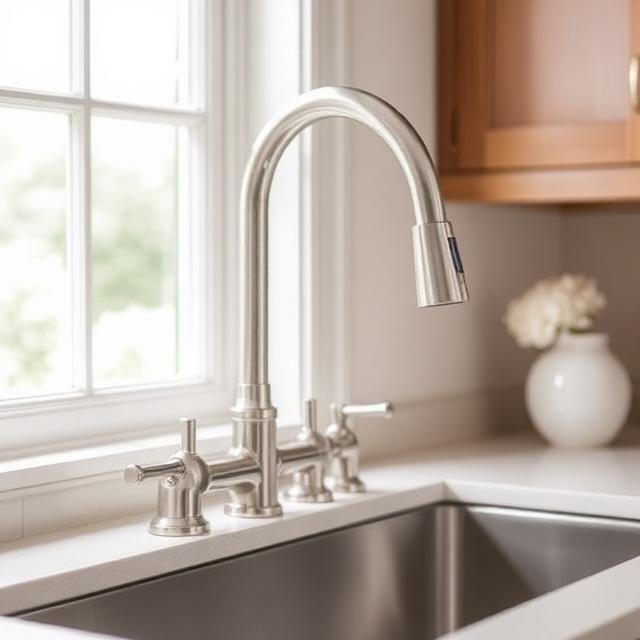
What Is a 3 Hole Kitchen Faucet and Why Does It Matter?
A 3 hole kitchen faucet is a faucet designed to fit a sink or countertop that has three pre-drilled holes. Typically, the holes are spaced 4 inches apart (center-to-center), and each hole serves a specific purpose: one for the hot water handle, one for the cold water handle, and one for the faucet spout itself. Some configurations use the third hole for an accessory like a side sprayer, soap dispenser, or water filtration tap.
Understanding what a 3 hole kitchen faucet is might seem straightforward at first, but many homeowners are surprised to learn that not all faucets fit all sinks. If your sink already has three holes drilled into it, you need a faucet designed specifically for that configuration. Using the wrong faucet means either leaving holes exposed — which looks unsightly and can allow water to seep under the countertop — or having to drill new holes, which is a costly and time-consuming process.
The 3 hole setup is one of the most popular configurations in American kitchens. According to the National Kitchen and Bath Association (NKBA), approximately 60% of kitchen sinks sold in North America come pre-drilled with either 3 or 4 holes, making the 3 hole kitchen faucet one of the most commonly purchased plumbing fixtures in the country. This widespread compatibility is one of the reasons so many faucet manufacturers prioritize designing products for this exact configuration.
How a 3 Hole Kitchen Faucet Differs From Other Configurations
Before purchasing a faucet, it’s important to understand how the 3 hole design compares to other configurations. Sinks can come with 1, 2, 3, or 4 holes, and each serves a different purpose.
| Faucet Configuration | Number of Holes | Best For |
|---|---|---|
| Single hole faucet | 1 hole | Minimalist kitchens, small sinks |
| 2 hole faucet | 2 holes | Basic setups with separate handles |
| 3 hole kitchen faucet | 3 holes | Most standard kitchens, versatile use |
| 4 hole faucet | 4 holes | Full accessory setup (sprayer + soap dispenser) |
The 3 hole kitchen faucet sits in the sweet spot of this range. It gives you enough flexibility to add accessories without the complexity of a 4-hole system. Most 3 hole faucets are designed with two separate handles for hot and cold water, but a significant number of modern designs use a single-handle design that mounts in the center hole while deck plates or escutcheons cover the remaining holes for a clean, finished look.
This flexibility is a huge reason why three hole kitchen faucets are so popular. A homeowner who already has a 3-hole sink can install a wide range of faucet styles without any modification to the sink or countertop.
5 Types of 3 Hole Kitchen Faucets You Should Know
Not all 3 hole kitchen faucets are built the same. The market offers a wide range of styles, mechanisms, and features. Here’s a breakdown of the most common types:
1. Two-Handle 3 Hole Kitchen Faucet
This is the most traditional style. The hot water handle occupies one hole, the cold water handle occupies another, and the spout fills the center. This design gives users precise control over water temperature and is generally easier to repair since each handle operates independently.
Best for: Classic and traditional kitchen designs, households with children (easier to teach specific temperature control).
2. Single-Handle 3 Hole Kitchen Faucet with Deck Plate
This setup uses a single-lever handle in the center hole. The other two holes are covered by a deck plate, which is often included with the faucet. This style looks clean and modern while still being compatible with a 3-hole sink.
Best for: Modern, minimalist kitchens. Also great for people who want to upgrade from a two-handle to a single-handle without replacing the sink.
3. Pull-Down 3 Hole Kitchen Faucet
A pull-down faucet features a high arc spout with a retractable spray head that pulls straight down. These are mounted in one hole while the remaining holes are either used for handles or covered with a deck plate. Pull-down models are currently among the most searched kitchen faucet styles on Google, reflecting their massive popularity.
Best for: Deep sinks, busy kitchens, rinsing large pots.
4. Pull-Out 3 Hole Kitchen Faucet
Similar to pull-down faucets, pull-out faucets feature a retractable spray head — but instead of pulling down, the spray head pulls forward and outward. They typically have a lower profile and work well in kitchens with overhead cabinet clearance issues.
Best for: Low-clearance kitchens, smaller sinks.
Suggested read: Kitchen Sink Accessories That Will Transform How You Cook, Clean, and Organize
5. Bridge-Style 3 Hole Kitchen Faucet
A bridge faucet connects two separate handles with a horizontal bar or “bridge” that arches over the sink. This classic farmhouse-inspired design is experiencing a major comeback in kitchen remodeling trends. It naturally occupies all three holes and gives kitchens a distinctive, vintage-inspired look.
Best for: Farmhouse kitchens, apron-front sinks, traditional or transitional design styles.
What to Look for When Buying a 3 Hole Kitchen Faucet
Choosing the right 3 hole kitchen sink faucet involves more than just picking a style you like. There are several critical technical and practical factors to evaluate before making a purchase.
Hole Spacing (Center-to-Center Distance)
The most important measurement when buying a 3 hole kitchen faucet is the center-to-center distance between the holes. The two most common spacings are:
- 4-inch spread – The most common standard in American kitchens
- 8-inch spread – Used in larger, wider sinks and custom installations
Always measure your sink’s hole spacing before shopping. Buying a faucet that doesn’t match your sink’s spacing means it won’t install properly without modification.
Faucet Height and Spout Reach
Faucet height determines how much vertical clearance you have above the sink. Spout reach determines how far into the sink the water stream travels. For deep farmhouse sinks, a taller faucet with a longer reach is essential. For shallow sinks under cabinets, a lower-profile faucet prevents clearance issues.
| Sink Type | Recommended Faucet Height | Recommended Spout Reach |
|---|---|---|
| Standard kitchen sink | 8–12 inches | 7–9 inches |
| Deep farmhouse sink | 12–20 inches | 8–11 inches |
| Shallow/bar sink | 6–8 inches | 5–7 inches |
Material and Finish
The material of your faucet body affects both longevity and appearance. Here are the most common materials used in 3 hole kitchen faucets:
- Brass – The gold standard for durability. Resistant to corrosion and mineral buildup. Most premium faucets use solid brass bodies.
- Zinc alloy – More affordable but less durable than brass. Common in budget faucets.
- Stainless steel – Corrosion-resistant and hygienic. Popular in commercial-style kitchen faucets.
- Plastic/composite – Found only in the lowest price tier. Not recommended for long-term use.
Finish options include:
| Finish | Durability | Style | Maintenance |
|---|---|---|---|
| Chrome | High | Modern/Traditional | Easy to clean |
| Brushed Nickel | High | Contemporary | Hides fingerprints |
| Matte Black | Medium-High | Modern/Industrial | Shows water spots |
| Oil-Rubbed Bronze | Medium | Rustic/Traditional | Requires polishing |
| Polished Gold | Medium | Luxury | Requires care |
Valve Type
The valve is the internal mechanism that controls water flow. The two best valve types are:
- Ceramic disc valves – The most durable option. They use two ceramic discs that slide against each other to control flow. Nearly drip-free and last for decades with minimal maintenance. Look for faucets rated at 500,000 cycles or more.
- Ball valves – Used mostly in single-handle faucets. Reliable, but the ball and springs can wear out over time.
Avoid faucets with compression valves — these are old technology that tends to drip and requires more frequent repairs.
Flow Rate (GPM)
Water efficiency matters both for your utility bill and the environment. Modern 3 hole kitchen faucets must comply with federal standards that cap flow at 2.2 gallons per minute (GPM) at 60 PSI. However, many WaterSense-certified faucets operate at 1.5 GPM or less without sacrificing water pressure.
“WaterSense-labeled faucets and accessories can reduce a sink’s water flow by 30% or more without sacrificing performance.”
— U.S. Environmental Protection Agency (EPA)
Choosing a water-efficient 3 hole kitchen faucet can save the average household 700+ gallons of water per year according to EPA data.
Top 7 Best 3 Hole Kitchen Faucets on the Market
Here are seven highly rated 3 hole kitchen faucets across a range of price points and styles, based on consumer reviews, expert ratings, and performance data.
1. Moen Adler Two-Handle Kitchen Faucet (Best Budget Pick)
- Price range: $80–$120
- Configuration: 2-handle, 3-hole compatible
- Finish options: Chrome, Spot Resist Stainless
- Flow rate: 1.5 GPM
- Warranty: Limited lifetime
Why it stands out: The Moen Adler is consistently rated one of the best entry-level 3 hole kitchen faucets for its reliability, clean design, and Moen’s legendary lifetime warranty. It’s a perfect starting point for budget-conscious renovators who don’t want to sacrifice quality.
Suggested read: Best RV Kitchen Faucet Options That Are Actually Worth Your Money in 2026
2. Delta Essa Pull-Down Kitchen Faucet with Deck Plate (Best Single-Handle)
- Price range: $180–$250
- Configuration: Single-handle with deck plate (3-hole compatible)
- Finish options: Chrome, Stainless, Matte Black, Champagne Bronze
- Flow rate: 1.8 GPM
- Special features: MagnaTite docking, Diamond Seal Technology
Why it stands out: Delta’s MagnaTite docking uses a powerful magnet to keep the spray head securely in place when not in use — a brilliant solution that prevents the drooping spray head problem that plagues many pull-down faucets. The Diamond Seal Technology reduces leak points and is rated for over 5 million uses.
3. Kohler Artifacts Bridge Kitchen Faucet (Best Bridge Style)
- Price range: $350–$550
- Configuration: Bridge/two-handle, 3-hole
- Finish options: Polished Chrome, Vibrant Brushed Nickel, Oil-Rubbed Bronze
- Flow rate: 1.8 GPM
- Warranty: Limited lifetime
Why it stands out: If you have a farmhouse or traditional kitchen and want a 3 hole kitchen faucet that doubles as a design statement, the Kohler Artifacts Bridge is hard to beat. Its ceramic disc valves and solid brass body make it an incredibly durable investment.
4. Pfister Stellen Pull-Down Kitchen Faucet (Best Value for Features)
- Price range: $130–$180
- Configuration: Single-handle with deck plate
- Finish options: Stainless Steel, Tuscan Bronze
- Flow rate: 1.8 GPM
- Special features: React touchless technology available
Why it stands out: Pfister packs a lot of features into a mid-range price point. The Stellen model is WaterSense certified, has a high-arc pull-down spray head, and is backed by a Pforever Lifetime Warranty — one of the most comprehensive warranties in the faucet industry.
5. American Standard Edgewater Two-Handle Kitchen Faucet (Best Traditional Look)
- Price range: $150–$220
- Configuration: 2-handle, 3-hole
- Finish options: Polished Chrome, Satin Nickel
- Flow rate: 1.5 GPM
- Warranty: Limited lifetime
Why it stands out: American Standard has been manufacturing plumbing fixtures since 1875, and the Edgewater reflects decades of engineering refinement. Its classic two-handle design and solid brass construction make it one of the most reliable three hole kitchen faucets on the market.
6. Kraus Bolden Pull-Down Kitchen Faucet (Best Commercial Style)
- Price range: $200–$300
- Configuration: Single-handle with deck plate
- Finish options: Matte Black, Spot-Free Stainless, Chrome, Brushed Gold
- Flow rate: 1.75 GPM
- Special features: QuickDock mounting, commercial-style coiled hose
Why it stands out: The Kraus Bolden brings the professional kitchen aesthetic into the home. Its commercial-style coiled hose and high-arc neck make it a dramatic focal point in any kitchen. The QuickDock installation system makes setup significantly faster than most competing 3 hole kitchen faucets.
7. Grohe Ladylux Pull-Out Kitchen Faucet (Best Premium Pick)
- Price range: $350–$500
- Configuration: Single-handle with deck plate
- Finish options: Chrome, SuperSteel, Brushed Nickel
- Flow rate: 1.75 GPM
- Special features: SilkMove ceramic cartridge, EcoJoy water-saving technology
Why it stands out: Grohe is a German-engineered brand known for exceptional build quality. The SilkMove cartridge provides buttery-smooth handle operation that you’ll notice every single day. The EcoJoy system limits flow without reducing perceived water pressure, saving up to 50% more water than standard faucets.
How to Install a 3 Hole Kitchen Faucet: Step-by-Step
Installing a 3 hole kitchen faucet is a project most handy homeowners can complete in 1–2 hours with the right tools and preparation. Here’s what the process looks like:
Tools you’ll need:
- Adjustable wrench or basin wrench
- Plumber’s putty or silicone sealant
- Teflon tape (plumber’s tape)
- Bucket and towels
- Flashlight
- Safety glasses
Step 1: Turn off the water supply
Locate the shut-off valves under the sink and turn them clockwise until fully closed. Turn on the faucet to release any remaining water pressure in the lines.
Step 2: Disconnect the old faucet
Use your basin wrench to loosen the nuts securing the supply lines and the mounting hardware of your old faucet. Have a bucket ready — some water will spill when you disconnect the lines.
Step 3: Remove the old faucet and clean the sink deck
Once the hardware is removed, lift out the old faucet. Clean the sink deck thoroughly to remove any old putty, mineral deposits, or debris. This ensures a proper seal for your new 3 hole kitchen faucet.
Step 4: Apply sealant
If your new faucet comes with a rubber or foam gasket, you can skip the putty. If not, apply a thin rope of plumber’s putty around the base of each faucet component before placing it into the holes.
Step 5: Feed components through the holes
Lower each part of the faucet through the appropriate holes from above. Make sure the hot water side goes to the left hole and cold to the right (when facing the sink).
Step 6: Secure from below
From under the sink, thread on the mounting nuts and tighten them securely with your basin wrench. Don’t overtighten — you risk cracking the sink or warping the faucet base.
Step 7: Connect the supply lines
Wrap the threads on the supply line connections with Teflon tape (2–3 wraps), then hand-tighten the connections before finishing with a wrench. Tighten an additional quarter turn with the wrench — no more.
Suggested read: Black Kitchen Sink: Transform Your Kitchen with Modern Elegance and Durability
Step 8: Turn on the water and check for leaks
Slowly open the shut-off valves and let water flow. Inspect all connections for drips. If you see a leak, tighten the relevant connection slightly. Run both hot and cold water to test full functionality.
Pro tip: Before sealing anything permanently, do a “test fit” of all components to make sure everything lines up correctly with your specific sink holes.
Case Study: Upgrading to a 3 Hole Kitchen Faucet in a 1990s Kitchen Remodel
The Situation:
A family in Columbus, Ohio undertook a partial kitchen remodel. Their sink was a 33-inch stainless steel drop-in with three pre-drilled holes at a standard 4-inch spread. The original faucet was a 25-year-old chrome two-handle model that dripped constantly and had significant mineral buildup.
The Problem:
They wanted to upgrade to a pull-down style but assumed they’d need a new sink because of the multiple holes. A contractor quoted them $800 just for sink replacement.
The Solution:
A plumber pointed out that they could install a single-handle pull-down 3 hole kitchen faucet with a deck plate — which would use the center hole for the faucet and cover the other two with a matching deck plate. They chose the Delta Essa in Matte Black at $220.
The Result:
- Total project cost: $220 for the faucet + $80 for professional installation = $300
- Saved $500+ compared to the sink replacement quote
- Water usage dropped from an estimated 2.2 GPM to 1.8 GPM
- The homeowners reported dramatically improved kitchen aesthetics and faster dish-rinsing with the pull-down spray head
“We had no idea we could keep our existing sink and still get the modern faucet we wanted. The deck plate covers the extra holes perfectly — you can barely tell it’s there.”
— Homeowner, Columbus, Ohio
This case study perfectly illustrates why the 3 hole kitchen faucet is such a versatile solution: it accommodates both traditional two-handle setups and modern single-handle designs, giving homeowners flexibility without requiring expensive structural changes.
Common Mistakes to Avoid When Choosing a 3 Hole Kitchen Faucet
Even experienced DIYers make mistakes when shopping for a three hole kitchen faucet. Here are the most common pitfalls and how to avoid them:
- Not measuring hole spacing before buying – Always confirm whether your sink has a 4-inch or 8-inch center-to-center spread before purchasing any faucet.
- Ignoring spout reach – A faucet with a short spout reach on a wide, deep sink means water splashes onto the front of the sink instead of landing in the drain area.
- Buying based on looks alone – A beautiful faucet with poor valve quality will need replacing within a few years. Always check the valve type and read long-term user reviews.
- Forgetting to buy supply lines – Many faucets don’t include supply lines. Make sure you have the right braided stainless steel lines for your connection type.
- Overlooking water pressure compatibility – Some faucet designs require a minimum water pressure of 30–45 PSI to function properly. If your home has low water pressure, check the manufacturer’s specs carefully.
- Skipping the warranty check – A faucet without a strong warranty is a red flag. Reputable brands like Moen, Delta, Kohler, and Pfister all offer limited lifetime warranties on their residential products.
3 Hole Kitchen Faucet Price Ranges: What to Expect
Budgeting for a 3 hole kitchen faucet doesn’t have to be guesswork. The table below gives a realistic breakdown of what different price tiers offer:
| Price Range | What You Get | Best For |
|---|---|---|
| Under $100 | Basic two-handle, zinc body, limited finish options, short warranty | Rental properties, tight budgets |
| $100–$200 | Solid entry-level quality, brass or zinc body, ceramic valves, decent warranty | Average homeowners |
| $200–$400 | High-quality brass body, advanced spray functions, multiple finishes, lifetime warranty | Kitchen remodels, mid-range homes |
| $400–$700 | Premium brands, advanced technology (touchless, temperature memory), superior finishes | High-end kitchens |
| $700+ | Luxury European brands, architectural designs, custom finishes | Luxury homes, custom kitchens |
The sweet spot for most homeowners falls in the $150–$350 range — here you get quality ceramic disc valves, solid brass construction, reliable warranty coverage, and a wide variety of finishes and styles without paying luxury-brand premiums.
Sustainability and Water Efficiency in a 3 Hole Kitchen Faucet
Modern 3 hole kitchen faucets are far more water-efficient than older models. The EPA’s WaterSense program certifies faucets that use 1.5 GPM or less while meeting strict performance standards. Choosing a WaterSense-certified 3 hole kitchen faucet can result in:
- Saving up to 700 gallons of water per year compared to standard 2.2 GPM faucets
- Reducing water heating costs since less hot water is used
- Lowering your household’s carbon footprint
Some advanced models also incorporate flow-limiting aerators that can be adjusted based on your needs. Replacing a non-efficient faucet aerator alone can make a significant difference — aerator upgrades cost as little as $5–$15 and can reduce flow to 0.5 GPM without noticeable pressure loss during hand washing.
“If every home in the U.S. replaced its older, inefficient faucets and aerators with WaterSense-labeled models, we could save 60 billion gallons of water annually.”
— U.S. EPA WaterSense Program
Ready to Upgrade? Find the Perfect 3 Hole Kitchen Faucet for Your Home
Whether you’re renovating a dated kitchen or simply replacing a leaking faucet, choosing the right 3 hole kitchen faucet is one of the highest-impact upgrades you can make to your kitchen. It improves functionality, boosts aesthetics, and can even lower your monthly water bill.
Suggested read: Transform Your Cooking Space: Kitchen Wallpaper Ideas That Actually Work
Take these next steps to find your ideal match:
- Measure your sink’s hole spacing (4-inch or 8-inch spread)
- Decide on your preferred style (two-handle, single-handle, pull-down, pull-out, or bridge)
- Set your budget using the price range guide above
- Choose a finish that complements your existing hardware
- Check the warranty before finalizing your purchase
👉 Browse top-rated 3 hole kitchen faucets at American Standard →
Frequently Asked Questions About 3 Hole Kitchen Faucets
What is a 3 hole kitchen faucet?
A 3 hole kitchen faucet is a faucet designed for sinks with three pre-drilled holes. The holes typically accommodate two handles (hot and cold) and a central spout, or a single-handle faucet with a deck plate covering the extra holes.
Can I use a single-handle faucet on a 3 hole sink?
Yes. Many single-handle faucets come with a deck plate that covers the two extra holes in a 3-hole sink, giving you a clean, modern look without having to modify your sink.
How far apart are the holes in a 3 hole kitchen sink?
The most common spacing is 4 inches center-to-center. Some larger sinks use an 8-inch spread. Always measure before purchasing a 3 hole kitchen faucet.
How long does a 3 hole kitchen faucet last?
A quality 3 hole kitchen faucet with ceramic disc valves and a solid brass body can last 20–30 years with minimal maintenance. Budget faucets with zinc bodies may need replacement within 5–10 years.
Do all 3 hole kitchen faucets include a deck plate?
Not always. Some faucets are designed exclusively as two-handle configurations and do not include a deck plate. If you want a single-handle faucet for a 3-hole sink, confirm that the product includes or sells a compatible deck plate before buying.
What is the best brand for a 3 hole kitchen faucet?
The most consistently recommended brands for three hole kitchen faucets are Moen, Delta, Kohler, Pfister, American Standard, Kraus, and Grohe. Each offers different price points and styles, but all are backed by strong warranties and reliable customer support.
Is a 3 hole kitchen faucet hard to install?
For a moderately handy homeowner, installing a 3 hole kitchen faucet takes about 1–2 hours. The most challenging part is usually working in the tight space under the sink to tighten mounting hardware. A basin wrench makes this significantly easier.
What GPM should I look for in a 3 hole kitchen faucet?
For a balance of efficiency and performance, look for a 3 hole kitchen faucet rated at 1.5–1.8 GPM. WaterSense-certified models at 1.5 GPM provide strong water pressure while conserving water.
Can I add a soap dispenser to a 3 hole kitchen faucet setup?
Yes — if your 3 hole kitchen sink faucet uses a two-handle configuration, the third hole can be used for a soap dispenser, side sprayer, or water filtration tap instead of a faucet handle.
How do I know if my sink has a 3 hole configuration?
Look at your sink deck (the flat area surrounding the basin). Count the drilled holes. A 3-hole sink will have exactly three circular openings, typically in a row. If they are currently occupied by your existing faucet and accessories, you’ll see three separate components or a single faucet with a deck plate covering the remaining holes.
Citation:
American Standard. (2024). Kitchen Faucet Buying Guide. Retrieved from https://www.americanstandard-us.com/kitchen-faucets
U.S. Environmental Protection Agency. (2024). WaterSense: Bathroom and Kitchen Faucets. Retrieved from https://www.epa.gov/watersense/bathroom-faucets
National Kitchen and Bath Association (NKBA). (2023). Kitchen Sink and Faucet Trends Report.

