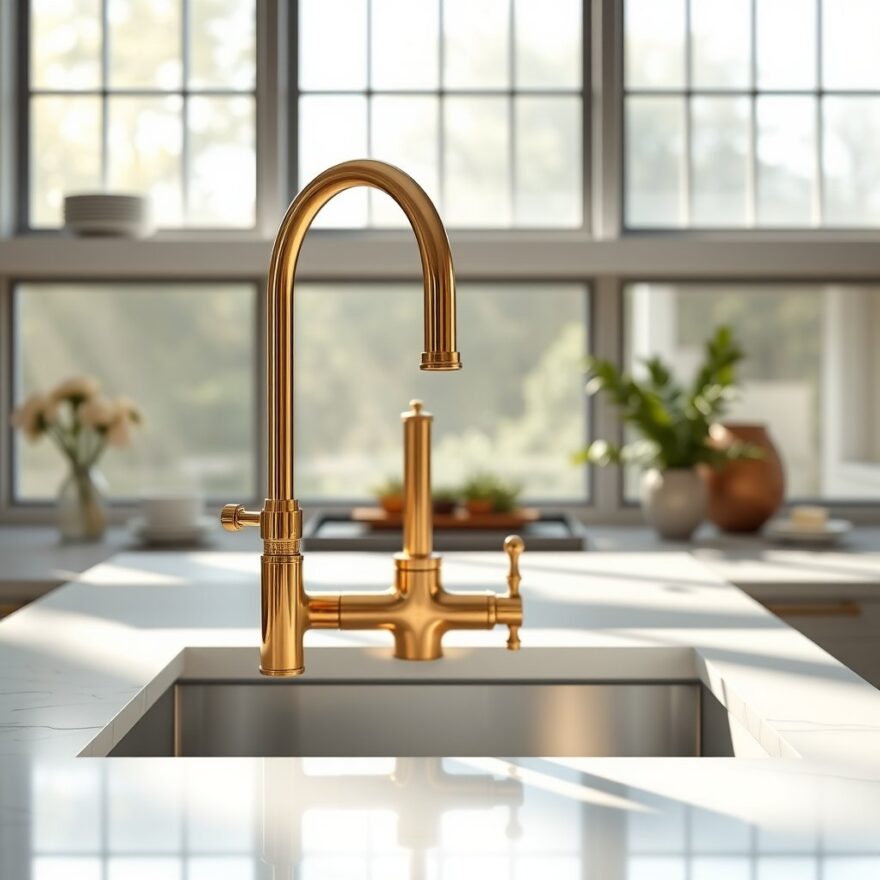
What Is a Brass Kitchen Faucet? {#what-is}
A brass kitchen faucet is a faucet made primarily from brass — an alloy composed of copper and zinc — used as the base material for its body, valves, and internal components. Brass has been a trusted plumbing material for centuries, and for very good reason. It resists corrosion, handles high water pressure with ease, and tolerates extreme temperature changes without cracking or warping. Unlike cheaper faucets made from plastic or zinc alloy (zamak), a solid brass kitchen faucet is built to last for decades under daily use.
When people search for a “brass kitchen faucet,” they are often looking for one of two things: either a faucet with a brass-toned finish (gold-like appearance) or a faucet with a solid brass body — and ideally, both. Understanding this distinction is important before making a purchase because not all faucets that look gold or brass-colored are actually made of brass internally. Always check the product specifications for “solid brass construction” or “brass body.”
Brass faucets have seen a massive resurgence in popularity over the past decade, driven by the rise of warm-toned kitchen design trends like farmhouse, transitional, and maximalist aesthetics. According to Houzz’s 2023 Kitchen Trends Report, gold and brass-toned fixtures ranked among the fastest-growing finish preferences for kitchen remodels in the United States, with a 32% year-over-year increase in homeowner interest.
“Brass is having a design moment — and unlike other trend-driven finishes, it has the staying power of a true classic.” — Elle Decor, 2023 Kitchen Design Trends
Why Choose a Brass Kitchen Faucet? {#why-choose}
Choosing a brass kitchen faucet is one of those decisions that pays dividends in both form and function. Here is a deep dive into why brass stands apart from other faucet materials.
Exceptional Durability
Brass is one of the most durable materials used in plumbing. Its natural resistance to corrosion means it won’t rust, pit, or degrade when exposed to water, soap, and daily use. Industry studies show that high-quality brass faucets can last 20 to 30 years or more with proper maintenance — far outlasting chrome-plated zinc or plastic alternatives that typically need replacement every 5 to 10 years.
Antimicrobial Properties
One underappreciated benefit of brass is its natural antimicrobial effect. Copper — a key component of brass — has been scientifically proven to kill bacteria, viruses, and fungi on contact. A study published in the Journal of Hospital Infection found that copper alloy surfaces, including brass, reduced microbial contamination by up to 99.9% compared to stainless steel. This makes a brass kitchen faucet not just a stylish choice, but a genuinely hygienic one for food-preparation areas.
Timeless Aesthetic Appeal
Brass has a warmth and richness that no synthetic finish can fully replicate. Whether you choose a polished brass kitchen faucet for a vintage, glamorous look or a brushed brass kitchen faucet for a more subdued, contemporary feel, brass adds character to any kitchen. It pairs beautifully with:
- White or cream cabinetry — classic, farmhouse, or cottage style
- Navy or dark green cabinets — bold, maximalist kitchens
- Natural wood tones — warm, organic, Scandinavian-inspired spaces
- Marble or quartz countertops — luxurious, high-end aesthetics
- Concrete or industrial surfaces — eclectic, modern kitchens
Excellent Resale Value
Home buyers increasingly view premium kitchen fixtures as a sign of overall home quality. Installing a solid brass kitchen faucet can contribute to a higher perceived value of your home. According to Remodeling Magazine’s 2023 Cost vs. Value Report, kitchen upgrades — including fixtures — consistently rank among the top ROI improvements for homeowners.
Eco-Friendly and Recyclable
Brass is 100% recyclable. At the end of its (very long) useful life, a brass faucet can be melted down and repurposed without any loss in material quality. This makes it a more sustainable choice than faucets made from composite plastics or non-recyclable alloys.
Types of Brass Kitchen Faucets {#types}
Not all brass kitchen faucets are the same. They come in a wide variety of styles and configurations to suit different kitchen layouts and personal preferences. Here is a comprehensive breakdown.
1. Single-Handle Brass Kitchen Faucet
The most popular configuration, a single-handle brass faucet controls both hot and cold water with one lever or knob. It is easy to use, requires only one hole in the sink or countertop, and has a clean, minimalist look. This is an excellent choice for smaller kitchens or anyone who values simplicity.
Best for: Small kitchens, minimalist designs, one-hole sink configurations.
2. Double-Handle Brass Kitchen Faucet
A two-handle brass kitchen faucet uses separate handles for hot and cold water. This style has a more traditional or vintage look and allows for very precise temperature control. It typically requires a three-hole sink installation.
Best for: Traditional kitchens, farmhouse styles, three-hole sinks, vintage aesthetics.
Suggested read: Kitchen & Table: How to Design, Style, and Elevate Your Dining Space in 2025
3. Pull-Down Brass Kitchen Faucet
A brass pull-down kitchen faucet features a spray head that pulls straight down into the sink, extending the reach of the faucet. This is extremely practical for washing large pots, rinsing produce, and cleaning the sink itself. Pull-down faucets have a high-arc spout that adds visual drama to the kitchen.
Best for: Large, deep sinks; busy cooks; anyone who values practicality and style equally.
4. Pull-Out Brass Kitchen Faucet
Similar to the pull-down, a pull-out brass faucet has a spray head that pulls out toward the user rather than down into the sink. Pull-out faucets are typically lower in profile and work better in kitchens with limited overhead cabinet space above the sink.
Best for: Kitchens with low overhead clearance, smaller sinks.
5. Bridge Brass Kitchen Faucet
A brass bridge faucet is a classic two-handle design where a horizontal “bridge” connects the hot and cold supply lines above the sink deck. This style is quintessentially vintage and works beautifully in farmhouse, Victorian, and cottage-style kitchens.
Best for: Farmhouse kitchens, vintage interiors, apron-front sinks.
6. Wall-Mount Brass Kitchen Faucet
A wall-mount brass kitchen faucet is mounted directly on the wall above the sink rather than on the countertop or sink deck. This frees up counter space, makes cleaning the sink much easier, and creates a striking, architectural look.
Best for: Apron-front sinks, industrial kitchens, design-forward spaces.
7. Commercial-Style Brass Kitchen Faucet
Inspired by professional restaurant kitchens, commercial-style brass faucets feature a high, coiled spring spout with a pull-down spray head. They are bold, functional, and make a serious design statement. Brands like Brizo, Kraus, and Rohl offer versions of this style in brass finishes.
Best for: Modern and industrial kitchens, serious home cooks.
Brass Finishes Compared {#finishes}
The finish of your brass kitchen faucet is one of the most important decisions you will make, as it dramatically affects the look, feel, and maintenance requirements of the fixture. Here is a detailed comparison of the most popular brass finishes.
| Finish | Appearance | Maintenance Level | Best Style Match | Price Premium |
|---|---|---|---|---|
| Polished Brass | Shiny, mirror-like gold | High (shows fingerprints) | Traditional, Hollywood Regency | Low–Medium |
| Brushed Brass | Matte, satin gold with texture | Low (hides fingerprints) | Contemporary, Transitional | Medium |
| Unlacquered Brass | Raw gold that patinas over time | Medium (regular oiling) | Farmhouse, Vintage, Organic | Medium–High |
| Antique Brass | Aged, darkened gold with depth | Low | Rustic, Victorian, Cottagecore | Low–Medium |
| Satin Brass | Soft, warm gold — similar to brushed | Low | Modern Farmhouse, Transitional | Medium |
| Champagne Bronze | Warm, slightly darker than satin brass | Low | Contemporary, Neutral kitchens | Medium–High |
| Venetian Bronze | Deep, oil-rubbed with brass undertones | Low | Mediterranean, Old World | Medium |
Unlacquered Brass: The Living Finish
The unlacquered brass kitchen faucet deserves special mention because of its unique character. Unlike coated brass finishes, unlacquered brass has no protective lacquer layer. This means it will gradually develop a natural patina — a darkening and mottling of the surface — over months and years of use, just as antique brass objects do.
This patina is not a defect. It is a feature that many homeowners specifically seek out. The patina gives the faucet a one-of-a-kind, lived-in beauty that factory finishes cannot replicate. To maintain an unlacquered brass faucet, you simply clean it with mild soap and water and occasionally polish it with a natural brass cleaner if you want to restore some of its original shine.
“Unlacquered brass is the only finish that truly improves with age. Every kitchen that uses it becomes uniquely its own.” — House Beautiful Magazine
Top Brass Kitchen Faucet Brands {#brands}
When shopping for a brass kitchen faucet, brand matters. Here are the most reputable brands known for quality, design, and longevity.
1. Rohl
Rohl is a premium American plumbing brand known for its high-end craftsmanship and European-inspired designs. Their brass kitchen faucets — particularly the Perrin & Rowe and Country Kitchen collections — are made with solid brass bodies and are available in unlacquered, polished, and satin brass finishes. Rohl faucets are typically sold through plumbing showrooms and high-end kitchen retailers.
Suggested read: Chinatown Kitchen: Everything You Need to Know About Its Bold Flavors, Dishes, and Culture
- Price range: $500 – $2,000+
- Best for: Luxury farmhouse, traditional, and transitional kitchens
- Notable model: Rohl Perrin & Rowe Bridge Faucet in Unlacquered Brass
2. Brizo
A luxury division of Delta Faucet Company, Brizo offers designer brass kitchen faucets with cutting-edge technology. Their Litze and Solna collections come in Luxe Gold (a warm brass tone) and feature innovations like SmartTouch technology (touchless activation) and MagneDock (magnetic docking of the spray head).
- Price range: $400 – $1,500+
- Best for: Contemporary, modern, and transitional kitchens
- Notable model: Brizo Litze Pull-Down Faucet in Luxe Gold
3. Kohler
Kohler offers one of the widest selections of brass kitchen faucets across all price points. From their affordable Simplice series to the premium Artifacts collection, Kohler provides consistent quality and a wide range of brass-toned finishes including Vibrant Brushed Moderne Brass and Vibrant Brushed Brass.
- Price range: $200 – $900+
- Best for: All kitchen styles, widely available
- Notable model: Kohler Artifacts Bridge Kitchen Faucet in Vibrant Brushed Moderne Brass
4. Moen
Moen is one of the most trusted faucet brands in North America, known for reliable performance and solid warranties. Their Brantford and Weymouth collections are popular antique brass kitchen faucet options. Moen’s MotionSense technology is also available in some brass-finish models for touchless operation.
- Price range: $150 – $600+
- Best for: Mid-range budgets, traditional and transitional kitchens
- Notable model: Moen Brantford Pull-Down Faucet in Antique Bronze/Brass
5. Kraus
Kraus offers excellent value for those who want the look of a brass kitchen faucet without the luxury price tag. Their Bolden and Artec Pro commercial-style faucets in Spot-Free Antique Champagne Bronze are particularly popular and receive consistently high ratings on Amazon and Home Depot.
- Price range: $100 – $350
- Best for: Budget-conscious buyers, modern and industrial kitchens
- Notable model: Kraus Bolden Commercial Kitchen Faucet in Antique Champagne Bronze
6. Delta
Delta is another household name offering durable brushed brass kitchen faucets with their Brilliance Champagne Bronze finish — a PVD (Physical Vapor Deposition) coating that is engineered to resist tarnishing, scratching, and corrosion. Delta’s Trinsic and Cassidy collections are widely available and highly rated.
- Price range: $150 – $700+
- Best for: Wide availability, reliable quality, all kitchen styles
- Notable model: Delta Trinsic Pull-Down Faucet in Champagne Bronze
How to Choose the Right Brass Kitchen Faucet {#how-to-choose}
Choosing the right brass kitchen faucet involves balancing aesthetics, practicality, and budget. Here is a step-by-step framework to guide your decision.
Step 1: Count Your Sink Holes
Before anything else, look under your sink and count the pre-drilled holes in your sink deck or countertop. This will determine which faucet configurations are compatible.
- 1 hole: Single-handle faucet or any faucet with a deck plate
- 2 holes: Rare — usually accommodates a single-handle faucet plus a separate side spray or soap dispenser
- 3 holes: Double-handle or bridge faucet; also works with a single-handle faucet using a deck plate
- 4 holes: Ideal for a two-handle faucet with a separate sprayer and/or soap dispenser
Step 2: Measure Your Sink and Counter Space
The spout height and reach of a brass kitchen faucet need to match the depth and width of your sink. Here are general guidelines:
- Spout height: Should be tall enough to fill large pots comfortably (8–10 inches is standard; high-arc faucets are 12–18+ inches)
- Spout reach: Should allow water to fall toward the center of the sink, not the edge (typically 8–10 inches of reach)
- Clearance: For pull-down faucets, make sure there is enough clearance between the spout and overhead cabinets
Step 3: Choose Your Finish Based on Your Kitchen’s Color Palette
Refer to the finish comparison table above. As a general rule:
- Polished brass pairs best with warm white, ivory, and jewel-tone cabinets
- Brushed or satin brass is the most versatile — it works with virtually any cabinet color
- Unlacquered brass suits earthy, organic kitchens with natural wood, stone, or linen tones
- Antique brass is ideal for rustic, country, or vintage-themed kitchens
Step 4: Decide on Spray Functions
Most brass pull-down kitchen faucets and pull-out faucets offer at least two spray modes: a stream for filling pots and glasses, and a spray/rinse mode for washing produce and rinsing dishes. Some premium models also offer:
- Pause function (stops water flow temporarily)
- TempSense LED (changes color based on water temperature)
- Sweep spray (wide, flat spray for clearing debris from the sink)
Step 5: Check the Valve Type
The valve is the heart of any faucet, controlling water flow and temperature. Look for faucets with these valve types for the best performance:
- Ceramic disc valves — the gold standard; virtually maintenance-free and drip-proof
- Ball valves — durable but may need occasional replacement of rubber seats
- Cartridge valves — easy to repair; most common in modern faucets
Avoid faucets with compression valves — these are old-fashioned, prone to dripping, and found mainly in very inexpensive models.
Step 6: Verify Water Efficiency (Flow Rate)
The EPA WaterSense label indicates that a faucet uses no more than 1.5 gallons per minute (GPM), which saves water without sacrificing performance. Standard kitchen faucets use 2.2 GPM. Choosing a WaterSense-certified brass kitchen faucet can save the average household 700+ gallons of water per year.
Brass Kitchen Faucet Price Guide {#price}
Understanding what you get at each price point helps you make a smarter investment.
| Price Range | What to Expect | Recommended For |
|---|---|---|
| Under $100 | Zinc alloy body with brass-tone finish; limited warranty | Rentals, temporary installs |
| $100 – $250 | Brass body possible; basic ceramic valve; 1–5 year warranty | Budget-conscious buyers |
| $250 – $500 | Solid brass body guaranteed; quality ceramic valve; good finish durability; lifetime warranty common | Most homeowners |
| $500 – $1,000 | Premium solid brass; designer collections; advanced spray tech; long warranty | Design-focused remodels |
| $1,000 – $2,000+ | Luxury craftsmanship; unlacquered or specialty finishes; showroom brands; custom options | Luxury kitchens |
Pro Tip: Avoid “brass-finish” faucets under $100 that don’t specify “solid brass body” or “brass construction” — these are almost certainly zinc alloy (zamak) with a surface coating that will peel or discolor within a few years.
Suggested read: Black Kitchen Sink: Transform Your Kitchen with Modern Elegance and Durability
Installation Tips for a Brass Kitchen Faucet {#installation}
Installing a brass kitchen faucet is a manageable DIY project for most homeowners with basic plumbing knowledge. Here is what you need to know.
Tools You Will Need
- Adjustable wrench or basin wrench
- Plumber’s putty or silicone sealant (check manufacturer recommendation)
- Teflon tape (plumber’s tape)
- Bucket and towels
- Flashlight
- Drill (if you need to create new sink holes)
Basic Installation Steps
- Turn off the water supply — shut off the hot and cold valves under the sink
- Turn on the existing faucet to release pressure and drain remaining water
- Disconnect the supply lines from the old faucet using an adjustable wrench
- Remove the old faucet — unscrew the mounting nuts from underneath the sink
- Clean the sink surface where the old faucet sat
- Apply plumber’s putty or silicone around the base of the new faucet (check manufacturer instructions — some faucets use a rubber gasket instead and require no putty)
- Insert the new faucet through the sink holes and hand-tighten the mounting nuts from below
- Connect the supply lines — wrap threads with Teflon tape first to prevent leaks
- Turn the water back on slowly and check for leaks
- Test all functions — stream, spray, hot/cold, and any special modes
When to Hire a Plumber
Hire a licensed plumber if:
- You need to add new sink holes
- Your shut-off valves are corroded or stuck
- You are installing a wall-mount faucet (requires opening the wall)
- You are unsure about your existing plumbing compatibility
The average cost to have a plumber install a kitchen faucet is $100 – $250 for labor, depending on your location and the complexity of the job.
Maintenance and Care for Your Brass Kitchen Faucet {#maintenance}
Proper care ensures your brass kitchen faucet looks beautiful and performs flawlessly for decades. Here is everything you need to know.
Daily Care
- Wipe down the faucet with a soft, damp cloth after use to prevent water spots and mineral buildup
- Dry the faucet with a microfiber towel to avoid water staining, especially with polished finishes
- Avoid leaving wet sponges or cloths draped over the faucet — prolonged moisture can affect some finishes
Weekly Cleaning
- Use a mild dish soap diluted in warm water to clean the entire faucet surface
- Rinse thoroughly with clean water and dry immediately
- For the aerator (the small screen at the tip of the spout): unscrew it monthly and rinse to prevent mineral clogging
What to Avoid
Never use the following on a brass kitchen faucet:
- Bleach or ammonia-based cleaners
- Abrasive scrubbers or steel wool
- Vinegar (safe for some finishes, damaging for unlacquered brass and some coatings)
- Commercial bathroom cleaners that contain harsh acids
Caring for Unlacquered Brass
An unlacquered brass kitchen faucet requires slightly more intentional care:
- Clean regularly with mild soap and water
- Polish every 3–6 months with a product like Brasso or Bar Keepers Friend if you want to slow patina development
- If you want the patina to develop naturally, simply clean and leave — the brass will age beautifully on its own
- Apply a thin coat of natural wax (like Renaissance Wax or beeswax) annually to protect the surface and control the patina
Dealing With Hard Water
If you live in an area with hard water (high mineral content), you may notice white or greenish mineral deposits building up around the base of your faucet and aerator. To remove these:
- Soak a cloth in diluted white vinegar (1:1 with water) and wrap it around the affected area for 30–60 minutes
- Gently scrub with a soft toothbrush
- Rinse and dry thoroughly
Note: Do not use undiluted vinegar directly on unlacquered brass or antique brass finishes, as it can strip the patina or damage the surface.
Case Studies: Real Kitchen Transformations with Brass Faucets {#case-studies}
Case Study 1: The Brooklyn Brownstone Renovation
A homeowner in Brooklyn, New York, renovated a 100-year-old brownstone kitchen. The design brief called for a vintage-inspired kitchen that honored the home’s architectural history while being functional for a modern family. The designer specified an unlacquered brass bridge kitchen faucet from Rohl’s Country Kitchen collection, paired with aged brass cabinet hardware and a farmhouse sink.
Result: The unlacquered brass faucet became the focal point of the kitchen. Within 18 months, it developed a warm, organic patina that perfectly complemented the reclaimed wood shelves and honed marble countertops. The homeowner reported that guests consistently comment on the faucet as the most beautiful element of the kitchen. Estimated cost of faucet: $850.
Case Study 2: The Suburban Kitchen Upgrade (Mid-Range Budget)
A family in suburban Chicago wanted to refresh their dated builder-grade kitchen without a full renovation. Their budget for the entire update was under $3,000. They chose a Kraus Bolden commercial-style kitchen faucet in Spot-Free Antique Champagne Bronze — a brushed brass alternative — at $219.
Result: The new faucet, combined with brushed brass cabinet hardware and a new light fixture, completely transformed the kitchen’s look. The homeowner noted that friends assumed they had replaced the entire kitchen rather than just fixtures and hardware. The faucet’s commercial spring design added functional height for filling large pots. Total fixture cost: $219. Perceived value upgrade: Significant.
Case Study 3: The Luxury New Build
A custom home builder in Scottsdale, Arizona, specified Brizo Litze pull-down faucets in Luxe Gold for all six kitchens in a luxury residential development. The specification was driven by the finish’s durability — Brizo’s PVD coating is warranted to never tarnish or corrode — and the touchless SmartTouch technology, which appealed to health-conscious buyers.
Result: The brass kitchen faucets became a key selling point in the development’s marketing materials. All six homes sold within 90 days of listing, with buyers specifically mentioning the kitchen finishes — including the brass faucets — as a deciding factor. Cost per faucet: $895.
Citation
According to the U.S. Environmental Protection Agency (EPA), WaterSense-labeled kitchen faucets and aerators can save the average American household more than 700 gallons of water per year. For more information on water-efficient brass kitchen faucets, visit the official EPA WaterSense program at https://www.epa.gov/watersense/kitchen-and-bathroom-faucets.
For additional research on brass as a plumbing material and its antimicrobial properties, see the Copper Development Association’s resources at https://www.copper.org.
Suggested read: Savera Indian Kitchen: Authentic Indian Flavors in Irving, TX You Need to Try
Ready to Upgrade? Shop Brass Kitchen Faucets Now
If you are ready to transform your kitchen with the timeless warmth and durability of a brass kitchen faucet, now is the perfect time to shop. Whether you are drawn to the raw, aging beauty of an unlacquered brass kitchen faucet, the everyday practicality of a brushed brass pull-down faucet, or the vintage glamour of a polished brass bridge faucet, there is a perfect brass faucet for every kitchen and every budget.
👉 Shop Brass Kitchen Faucets at Home Depot 👉 Explore Premium Brass Kitchen Faucets at Rohl 👉 Find Your Brass Kitchen Faucet on Amazon 👉 Browse Designer Brass Faucets at Brizo
Don’t settle for a generic chrome faucet that blends into the background. Choose a brass kitchen faucet that becomes the jewel of your kitchen — a fixture that looks better with every passing year.
Frequently Asked Questions About Brass Kitchen Faucets {#faqs}
Are brass kitchen faucets still in style?
Yes, absolutely. Brass kitchen faucets have made a major comeback in interior design and show no signs of slowing down. Warm metallic tones — including gold, brass, and bronze — have consistently ranked among the top finish trends in kitchen design reports from Houzz, NKBA (National Kitchen & Bath Association), and Architectural Digest. Unlike other trend-driven finishes that come and go quickly, brass has historical staying power and pairs well with the enduringly popular farmhouse, transitional, and maximalist kitchen styles.
Is a brass kitchen faucet better than stainless steel?
Both materials have distinct advantages, and “better” depends on your priorities. Brass kitchen faucets are superior in terms of antimicrobial properties, longevity (solid brass lasts longer than most steel alloys used in consumer faucets), and aesthetic warmth. Stainless steel faucets are easier to match with stainless steel appliances and sinks, tend to show fewer water spots, and are generally less expensive. If you have a warm-toned kitchen, brass almost always looks more cohesive. If your kitchen is cool-toned with stainless steel appliances, steel may be the better aesthetic choice.
How do I know if a faucet is solid brass or just brass-colored?
Read the product specifications carefully. Look for phrases like “solid brass body,” “solid brass construction,” or “lead-free brass.” If the spec sheet says “zinc alloy,” “zamak,” or simply “metal body” without specifying brass, it is likely not solid brass. You can also check the weight — solid brass faucets are noticeably heavier than zinc or plastic alternatives. When in doubt, buy from reputable brands and shop from authorized retailers.
Does an unlacquered brass kitchen faucet require a lot of maintenance?
More than a coated faucet, but not excessively. An unlacquered brass kitchen faucet needs regular cleaning with mild soap and water, occasional polishing (if you want to control patina development), and periodic waxing to protect the surface. If you embrace the natural patina process, the maintenance is actually quite low — you simply clean it and let it age. Many homeowners find this process deeply satisfying and love how the faucet develops a unique character over time.
Can I use a brass kitchen faucet with a stainless steel sink?
Yes. A brass kitchen faucet can look stunning against a stainless steel sink — the contrast between warm brass tones and cool steel creates an intentional, designer look. For the best result, consider mixing in other brass or warm metal accents in the kitchen (cabinet hardware, light fixtures, pot racks) so the brass faucet does not look like an isolated mismatch.
What is the best brass kitchen faucet for a farmhouse sink?
For a farmhouse (apron-front) sink, the best options are a brass bridge faucet or a wall-mount brass faucet. Bridge faucets have the classic, vintage look that complements farmhouse sinks beautifully. Wall-mount faucets free up the sink deck entirely and create a clean, architectural look. Top picks include the Rohl Country Kitchen Bridge Faucet in unlacquered brass, the Kohler Artifacts Bridge Faucet in Vibrant Brushed Moderne Brass, and the Kingston Brass Heritage Bridge Faucet in polished brass.
How long does a brass kitchen faucet last?
A high-quality solid brass kitchen faucet from a reputable brand can easily last 20 to 30 years or more with proper care. The internal ceramic disc valve — standard in most quality faucets — is virtually maintenance-free and rated for hundreds of thousands of cycles. The finish longevity varies: PVD-coated finishes (like Brizo’s Luxe Gold or Delta’s Champagne Bronze) are warranted against tarnishing for life; unlacquered brass will develop a patina but the underlying metal remains durable indefinitely; lacquered polished brass may eventually need refinishing after 10–15 years of heavy use.
Are brass kitchen faucets safe for drinking water?
Yes. Modern brass kitchen faucets sold in the United States are required to comply with the Safe Drinking Water Act and must meet NSF/ANSI 61 and NSF/ANSI 372 certification standards for lead-free construction. Federal law (the Reduction of Lead in Drinking Water Act) mandates that faucets sold for potable water use must contain no more than 0.25% weighted average lead content. Always look for “lead-free” or “NSF/ANSI 61 certified” on the product listing to confirm compliance.
What is the difference between brushed brass and satin brass?
Brushed brass and satin brass are very similar in appearance — both have a non-reflective, matte-to-semi-matte finish with visible brushing or texturing on the surface. The primary difference is subtle: brushed brass tends to have more visible linear texture from the brushing process and can appear slightly cooler in tone, while satin brass is often smoother and warmer. In practice, many manufacturers use these terms interchangeably, so the best approach is to look at the actual faucet photo or, ideally, see it in person at a showroom before purchasing.
How do I match a brass kitchen faucet with my existing hardware?
You do not need a perfect match — you need a cohesive finish family. Mixing warm metallic tones is completely acceptable and even encouraged in modern interior design. As a general rule, try to stay within the same tonal family (warm metals: brass, gold, bronze, copper) and avoid mixing warm and cool metals (e.g., brass and chrome) unless you are intentionally going for an eclectic, mixed-metal look. For example, a brushed brass kitchen faucet pairs naturally with brushed gold cabinet pulls, warm bronze light fixtures, and copper cookware displayed on open shelves.
This article was written for informational and purchasing-guidance purposes. Product prices and availability are subject to change. Always verify current pricing and specifications with the retailer before purchasing.
Last Updated: April 2026 Author: Expert Home Design & Plumbing Team Category: Kitchen Fixtures | Home Improvement | Interior Design

